About the Journal

The Colombian Journal of Advanced Technologies aims to disseminate high-impact research in advanced technologies, covering areas such as Telecommunications, Control and Automation, Mechatronics, Artificial Intelligence, Robotics, Power Electronics, Digital Signal Processing, Bioengineering, Software Engineering, Electrical Engineering, and more. It is oriented to be a reference channel for the exchange and development of scientific knowledge, contributing to the advancement of engineering and technology.

Published semiannually with national and international coverage, the journal provides a space for knowledge exchange among academics and researchers. In addition to original articles, the journal will publish reviews that examine the state of the art and suggest future directions in developing fields. Manuscripts must be submitted in both Spanish and English for peer evaluation.

The editorial management is led by the Vice-Rectorate for Research at the University of Pamplona, under the direction of Ph.D. Aldo Pardo García, with an editorial board of international experts.

Indexing: Latindex, Publindex, Dialnet, MIAR, REDIB, EBSCO, Google Schoolar, Otros.

Frequency: Biannual.

Print ISSN: 1692-7257, Online ISSN: 2500-8625

Publindex Category: B

Announcements

Regulatory Update: Change in IFAC Reference Format to IEEE

2024-02-01

We are pleased to inform our readers that we have made a significant modification to the reference guidelines for articles in our journal. We have now adopted the IEEE format to enhance consistency and standardization in the presentation of bibliographic citations. This update not only reflects our commitment to editorial quality but also facilitates the reading and understanding of the content.

Read more about Regulatory Update: Change in IFAC Reference Format to IEEE
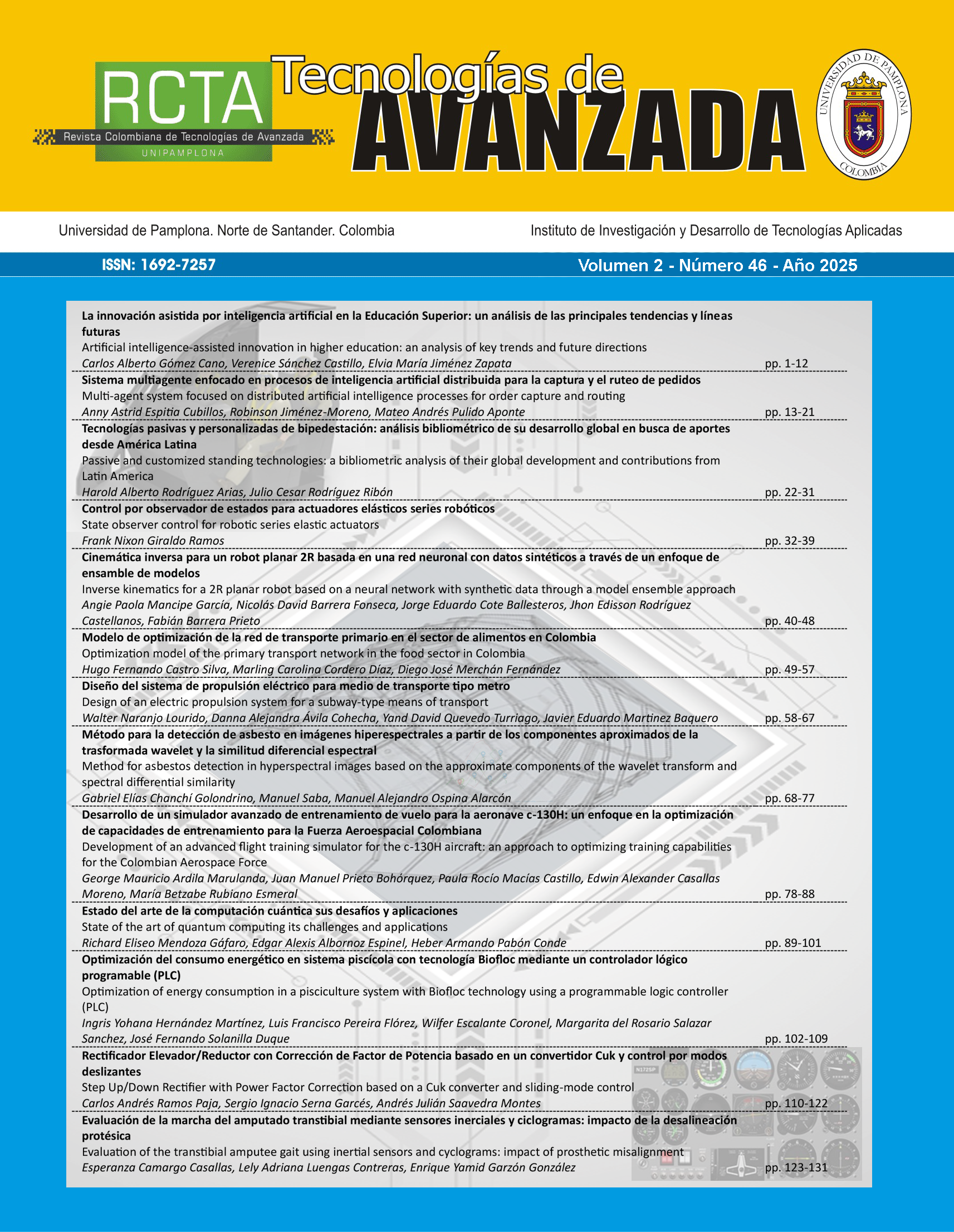
Current Issue

Vol. 2 No. 46 (2025): July - December
					View Vol. 2 No. 46 (2025): July - December
Published: 2025-07-01

Artículos

  • Artificial intelligence-assisted innovation in higher education: an analysis of key trends and future directions

    Carlos Alberto Gómez Cano, Verenice Sánchez Castillo, Elvia María Jiménez Zapata
    1-12
    DOI: https://doi.org/10.24054/rcta.v2i46.3743
  • Multi-agent system focused on distributed artificial intelligence processes for order capture and routing

    Anny Astrid Espitia Cubillos, Robinson Jiménez Moreno, Mateo Andrés Pulido Aponte
    13-21
    DOI: https://doi.org/10.24054/rcta.v2i46.3530
  • Passive and customized standing technologies: a bibliometric analysis of their global development and contributions from Latin America

    Harold Alberto Rodríguez Arias, Julio Cesar Rodríguez Ribón
    22-31
    DOI: https://doi.org/10.24054/rcta.v2i46.3783
  • State observer control for robotic series elastic actuators

    Frank Nixon Giraldo Ramos
    32-39
    DOI: https://doi.org/10.24054/rcta.v2i46.3801
  • Inverse kinematics for a 2R planar robot based on a neural network with synthetic data through a model ensemble approach

    Angie Paola Mancipe García, Nicolás David Barrera Fonseca, Jorge Eduardo Cote Ballesteros, Jhon Edisson Rodríguez Castellanos, Fabián Barrera Prieto
    40-48
    DOI: https://doi.org/10.24054/rcta.v2i46.3583
  • Optimization model of the primary transport network in the food sector in Colombia

    Hugo Fernando Castro Silva, Marling Carolina Cordero Díaz, Diego José Merchán Fernández
    49-57
    DOI: https://doi.org/10.24054/rcta.v2i46.4073
  • Design of an electric propulsion system for a subway-type means of transport

    Walter Naranjo Lourido, Danna Alejandra Ávila Cohecha, Yand David Quevedo Turriago, Javier Eduardo Martinez Baquero
    58-67
    DOI: https://doi.org/10.24054/rcta.v2i46.3550
  • Method for asbestos detection in hyperspectral images based on the approximate components of the wavelet transform and spectral differential similarity

    Gabriel Elías Chanchí Golondrino, Manuel Saba, Manuel Alejandro Ospina Alarcón
    68-77
    DOI: https://doi.org/10.24054/rcta.v2i46.3521
  • Development of an advanced flight training simulator for the c-130H aircraft: an approach to optimizing training capabilities for the Colombian Aerospace Force

    George Mauricio Ardila Marulanda, Juan Manuel Prieto Bohórquez, Paula Rocío Macías Castillo, Edwin Alexander Casallas Moreno, María Betzabe Rubiano Esmeral
    78-88
    DOI: https://doi.org/10.24054/rcta.v2i46.3668
  • State of the art of quantum computing its challenges and applications

    Richard Eliseo Mendoza Gáfaro, Edgar Alexis Albornoz Espinel, Heber Armando Pabón Conde
    89-101
    DOI: https://doi.org/10.24054/rcta.v2i46.4074
  • Optimization of energy consumption in a pisciculture system with Biofloc technology using a programmable logic controller (PLC)

    Ingris Yohana Hernández Martínez, Luis Francisco Pereira Flórez, Wilfer Escalante Coronel , Margarita Rosario Salazar Sanchez , José Fernando Solanilla Duque
    102-109
    DOI: https://doi.org/10.24054/rcta.v2i46.3561
  • Step Up/Down Rectifier with Power Factor Correction based on a Cuk converter and sliding-mode control

    Carlos Andrés Ramos Paja, Sergio Ignacio Serna Garcés, Andrés Julián Saavedra Montes
    110-122
    DOI: https://doi.org/10.24054/rcta.v2i46.3525
  • Evaluation of the transtibial amputee gait using inertial sensors and cyclograms: impact of prosthetic misalignment

    Esperanza Camargo Casallas, Lely Adriana Luengas Contreras, Enrique Yamid Garzón González
    123-131
    DOI: https://doi.org/10.24054/rcta.v2i46.4006
  • Digital substations: driving sustainability and cybersecurity in the power sector through emerging solutions

    Oscar Andrés Tobar Rosero, Luis Fernando Quintero Henao, Ernesto Pérez González
    132-140
    DOI: https://doi.org/10.24054/rcta.v2i46.4101
  • Design of an automated system for temperature and humidity control in a Pleurotus Ostreatus mushroom culture cell

    Edgar Rodrigo Enríquez Rosero, Gabriel Andrés Obando Obando
    141-149
    DOI: https://doi.org/10.24054/rcta.v2i46.4092
  • Sign language to text translation using Python with LSTM neural networks

    Luis Duván Torrado Mora, César Alberto Collazos, Dewar Rico Bautista
    150-159
    DOI: https://doi.org/10.24054/rcta.v2i46.4105
  • Implementation of a Real-Time Pressure and Tilt Angle Monitoring System for Mast Hoisting in NOV Rapid Rig 13 Equipment

    Elkin Adoniz Mora Castañeda, Oscar Javier Suarez Sierra, Rocco Tarantino Alvarado
    160-170
    DOI: https://doi.org/10.24054/rcta.v2i46.4115
  • Voice Driven UML Modeling System for Visually Impaired Students in Software Engineering Education

    Carlos, Malak Andres Sanchez Cataño, German Sanchez-Torres
    171-180
    DOI: https://doi.org/10.24054/rcta.v2i46.4126
  • Modal propagation analysis in waveguides for the design of evanescent wave photonic biosensors

    Jesús Álvarez Guerrero, Jhon Jairo Vejar Caballero, Byron Medina Delgado, Jhonattan Córdoba Ramírez, Ferney Orlando Amaya Fernández
    181-189
    DOI: https://doi.org/10.24054/rcta.v2i46.4122
  • Wifish: IoT and cloud computing-based aquaculture monitoring platform with AES-128 encryption

    Andrés Joshue Cuenca Luna, Rony David Quelal Villarreal, Fabricio Sebastián Donoso Martínez, Fabián Geovanny Cuzme Rodríguez, Pablo David Muñoz Criollo
    190-200
    DOI: https://doi.org/10.24054/rcta.v2i46.4140
  • Industrial control through reinforcement learning

    Yessica Cindy Mora Cubides, Daniel Steven Arias Otálora, José Antonio Tumialan Borja, Hugo Fernando Velasco Peña
    201-208
    DOI: https://doi.org/10.24054/rcta.v2i46.4141
  • Digital tool to optimize audits based on the ISO/IEC 27001:2022 standard

    Sebastian Buesaco, Alejandro Alcaraz Gaviria, Juan José Caiza Narváez, Katerine Marceles Villalba, Siler Amador Donado
    209-216
    DOI: https://doi.org/10.24054/rcta.v2i46.4111
View All Issues